03 Apr 2013
 Posted by Kyle Wachtel
In standard fantasy football leagues, running backs and wide receivers account for five of the eight starting slots; that is a quite large portion of your lineups. There are innumerable ways to go about filling those positions, but what way is the safest? It seems there are top running backs every year that go down with a torn ACL and shatter the championship dreams of many fantasy owners. So perhaps you should play it safer and spend you premium draft picks on wide receivers. The common perception is that they are less prone to significant injuries and there sure is a lot of passing in the NFL these days. I’m going to examine how well that strategy would have worked over the past three seasons.
I’ve compiled data for the top-twelve players at each position according to their preseason average draft position. Highlighted in green on the tables below are the final positional rankings inside the top-twelve of their position, which would denote a RB1/WR1 finish. Highlighted in red on the tables below are the final positional rankings that finished outside of the top-twenty-four at their position, which would place those players outside of RB2/WR2 territory.
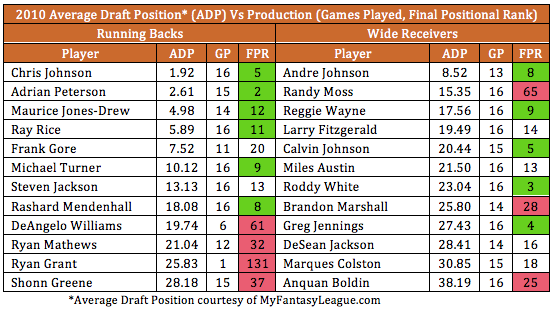
In 2010, by the time the twelfth running back went off of the board, nine wide receivers were drafted. The running backs combined to miss 38 games for an average of 3.17. The wide receivers missed only 9 games for an average of 0.75. Six of the running backs finished as RB1s, while four of them finished outside the position’s top-twenty-four. Five of the wide receivers finished as WR1s, while three of them finished outside the position’s top-twenty-four. Shonn Greene was the only running back whose poor production was not directly related to injury. Randy Moss, Brandon Marshall and Anquan Boldin all played at least 14 games, but did not finish as WR2s.
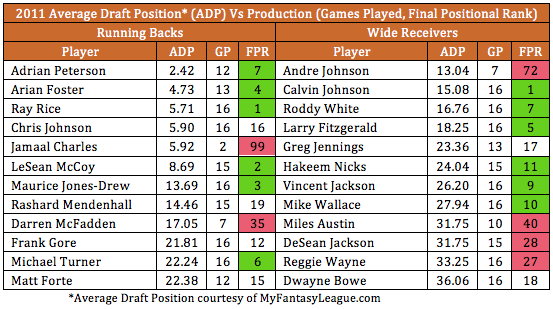
In 2011, by the time the twelfth running back went off of the board, only four wide receivers were drafted. The running backs combined to miss 35 games for an average of 3.0. The wide receivers missed 20 games for an average of 1.67. Six of the running backs finished as RB1s, while only two of them finished outside the position’s top-twenty-four. Six of the wide receivers finished as WR1s, while four of them finished outside the position’s top-twenty-four. The only two running backs that severely under produced were Jamaal Charles and Darren McFadden; both players had their seasons derailed by injuries. Four wide receivers finished worse than WR2s; two of them (DeSean Jackson and Reggie Wayne) played at least 15 games. The other two, Andre Johnson and Miles Austin were limited by injuries.
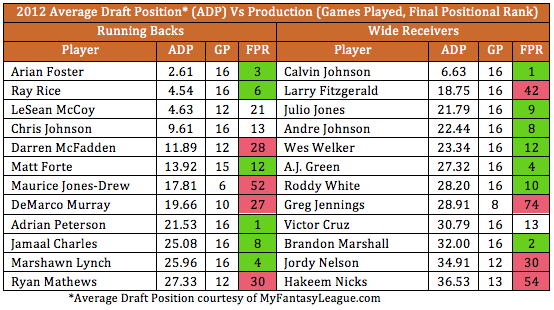
In 2012, by the time the twelfth running back went off of the board, six wide receivers were drafted. The running backs combined to miss 29 games for an average of 2.42. The wide receivers missed only 15 games for an average of 1.25. Six of the running backs finished as RB1s, while four of them finished outside the position’s top-twenty-four. All four of the running backs that under produced were limited to 12 games or less. Seven of the wide receivers finished as WR1s, while four of them finished outside the position’s top-twenty-four. Three of the four wide receivers that under produced played in 13 or less games.
Over all three seasons, the running backs missed a total of 102 games for an average of 2.8 per player. Thirteen running backs played in 12 or less games during a season. On the other hand, wide receivers only missed 44 games for an average of only 1.2 per player. Only four wide receivers were limited to 12 or less games in a season. That data proves that receivers have carried a substantially smaller risk of injury, but is that enough to spend your premium draft picks on that position? Let’s weigh the potential reward versus risk to find out.
In this instance, reward denotes a finish inside the top-twelve at their position. Of the 36 running backs and 36 wide receivers studied, 18 players at each position managed to rank as either RB1s or WR1s at the end of the season. Risk will be accounted for by the amount of players that under produced. 10 of the 36 running backs finished worse than RB2s, 5 of which finished ranked out of the top-36, meaning production worse than RB3s. As for wide receivers, 11 of them finished worse than WR2s, 6 of which finished as worse than WR3s. Therefore, even though the running backs missed more than double the amount of games as wide receivers, wide receivers still exhibited a slightly higher risk.
You can draw a lot of conclusions from this data, but the point I would like to stress is that the importance of high-end running backs further increases. Diminished risk of injury – one of the biggest perceived advantages that wide receivers held over running backs – turns out not to be much of an advantage after all. According to early 2013 ADP data from FantasyFootballCalculator.com, only four wide receivers are off of the board by the time the twelfth running back is drafted. That means you will have to act quickly if you’d like to shore up the running back position with high-end players. Outside of a bargain on Calvin Johnson, who has rewarded his owners every year, I won’t be spending a premium draft pick on a wide receiver this season. So to A.J. Green, Brandon Marshall, Julio Jones, Dez Bryant and Demaryius Thomas… I bid you adieu. My goal for the early rounds of 2013 fantasy football drafts will be to load up on the running back position as best I can and then take advantage of the wide receiver depth later on in the middle rounds.